

A brand is one of the most valuable assets a business can build. Whether you operate a startup, retail shop, manufacturing company, online store or service-based business, your brand name and logo help customers recognize your products and services.
However, using a brand in the marketplace does not automatically mean that you have registered it as a trademark.
Trademark registration in Pakistan provides a legal process for seeking protection for a distinctive brand name, logo or other eligible mark. Registration can help businesses establish their trademark rights, protect their identity and take appropriate action against conflicting marks or unauthorised use, subject to applicable law.
In Pakistan, trademark registration is administered through the Intellectual Property Organization of Pakistan (IPO-Pakistan) under the Trade Marks Ordinance, 2001, and the applicable Trade Marks Rules, 2004.
This guide explains how trademark registration works, what documents businesses may need, how to select the correct trademark class and what to consider before submitting an application.
What Is Trademark Registration?
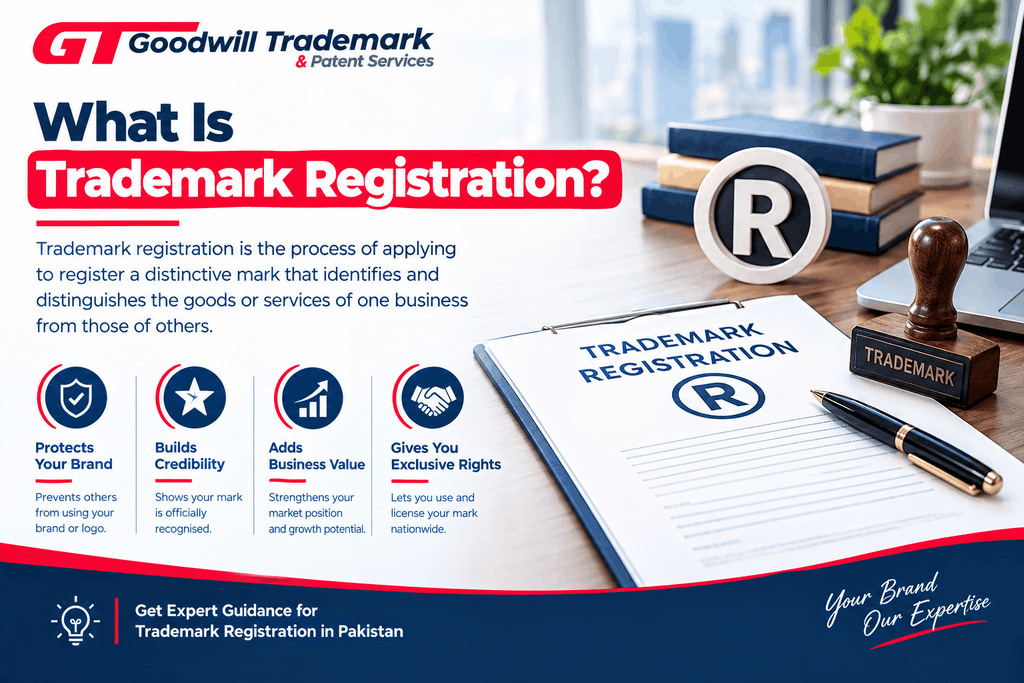
Trademark registration is the process of applying to register a distinctive mark that identifies and distinguishes the goods or services of one business from those of others.
A trademark can include a brand name, logo, word, symbol or another sign that qualifies for protection under the applicable law.
For example, a business may seek trademark protection for:
- Its company or product brand name
- Its business logo or symbol
- The name of a product range
- A distinctive service brand
- A qualifying slogan or other brand element
The availability of protection depends on the mark itself, its use, the relevant goods or services and the legal requirements.
Trademark registration is different from company registration, business-name registration, domain-name registration and copyright registration. Completing one of these processes does not automatically provide trademark registration.
Why Is Trademark Registration Important for Pakistani Businesses?

Businesses invest time and money in developing their names, logos, packaging, advertising and customer relationships. Protecting the identity associated with that investment is an important part of brand management.
1. Protect Your Brand Identity
Trademark registration can help establish legal rights in your registered mark for the goods or services covered by the registration.
2. Reduce the Risk of Brand Conflicts
A trademark search before filing can help identify potentially conflicting marks and reduce the risk of avoidable disputes.
3. Build Customer Recognition
A consistent and protected brand can help customers distinguish your business from competitors.
4. Support Business Growth
Businesses planning to expand their product lines, distribution networks or market presence should consider trademark protection as part of their growth strategy.
5. Strengthen Your Legal Position
A registered trademark can provide an important basis for pursuing remedies against infringement, subject to the facts of the case and applicable law.
6. Support Brand Licensing and Transfers
Trademark rights may be licensed or assigned in accordance with applicable legal requirements. This can be relevant when businesses enter commercial partnerships, franchise arrangements
or other transactions.
Who Can Apply for Trademark Registration in Pakistan?
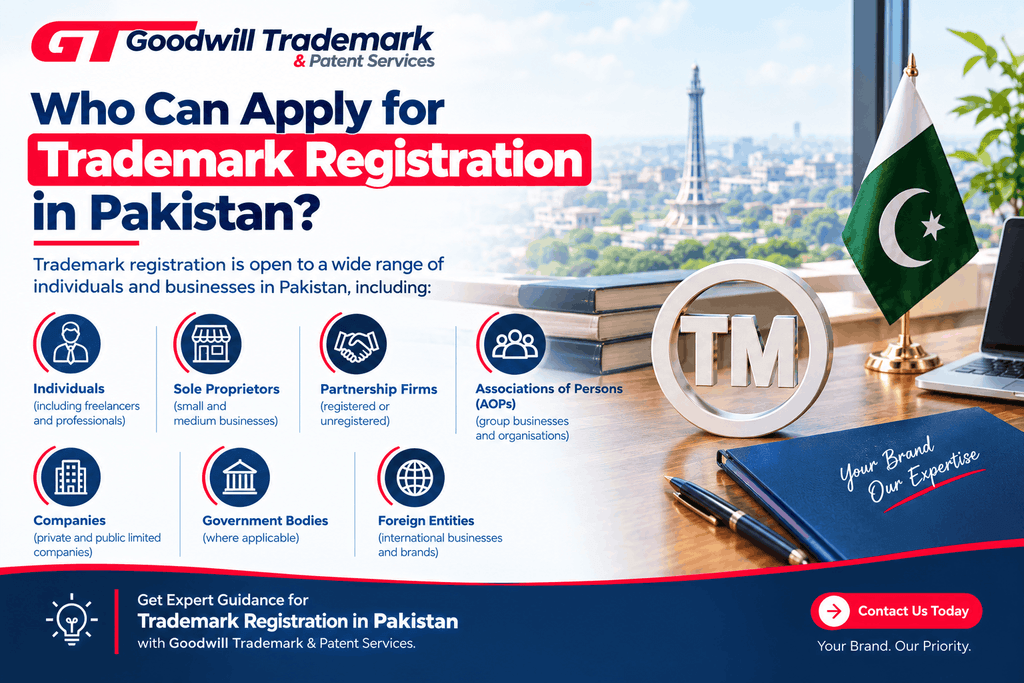
Depending on the applicable requirements, an application may be filed by an eligible individual or business entity claiming ownership of the mark.
Applicants may include:
- Sole proprietors
- Individual entrepreneurs
- Partnership firms
- Association of Persons (AOPs)
- Private limited companies
- Public limited companies
- Manufacturers and product distributors
- Retail and e-commerce businesses
- Service providers
- Startups and established brands
The applicant should be the correct owner of the trademark. Choosing the owner carefully is important because changing ownership later may require additional documentation and formalities.
A business should also consider whether the trademark should be owned by an individual, a partnership or a company, particularly where several founders or related businesses are involved.
What Can Be Registered as a Trademark?
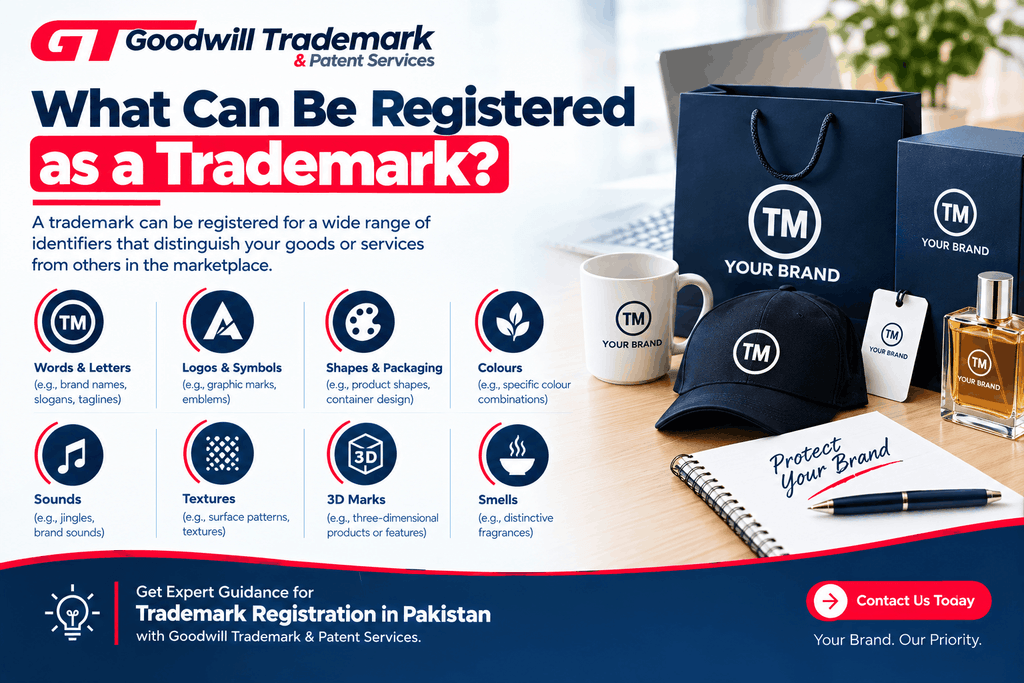
The mark must satisfy the applicable legal requirements, including distinctiveness and any relevant restrictions.
Brand Names and Word Marks
A word mark protects the qualifying word or name itself, subject to the scope of registration and applicable law.
Logos and Brand Symbols
A logo application seeks protection for the particular visual mark represented in the application.
Product and Service Brands
Businesses can seek protection for marks associated with eligible goods or services in the relevant trademark classes.
Slogans and Other Brand Elements
Certain slogans or other brand elements may qualify if they meet the legal requirements.
Not every name, phrase or symbol can be registered. Marks that lack distinctiveness, describe the relevant goods or services, conflict with earlier rights or fall within other legal restrictions may face objections or refusal.
Trademark Search Before Registration
Before filing an application, a business should check whether an identical or similar trademark already exists for related goods or services.
A search can help identify potential conflicts involving:
- Identical brand names
- Similar spellings
- Similar pronunciations
- Similar logos or visual elements
- Earlier marks in related goods or services
- Other potentially relevant registered or pending marks
A search is an important preliminary step, but it does not guarantee registration. The legal assessment may also depend on the nature of the marks, their goods or services, the relevant records and other circumstances.
Practical tip: Search for your preferred brand name before investing heavily in packaging, advertising, signage or product launches.
Understanding Trademark Classes in Pakistan
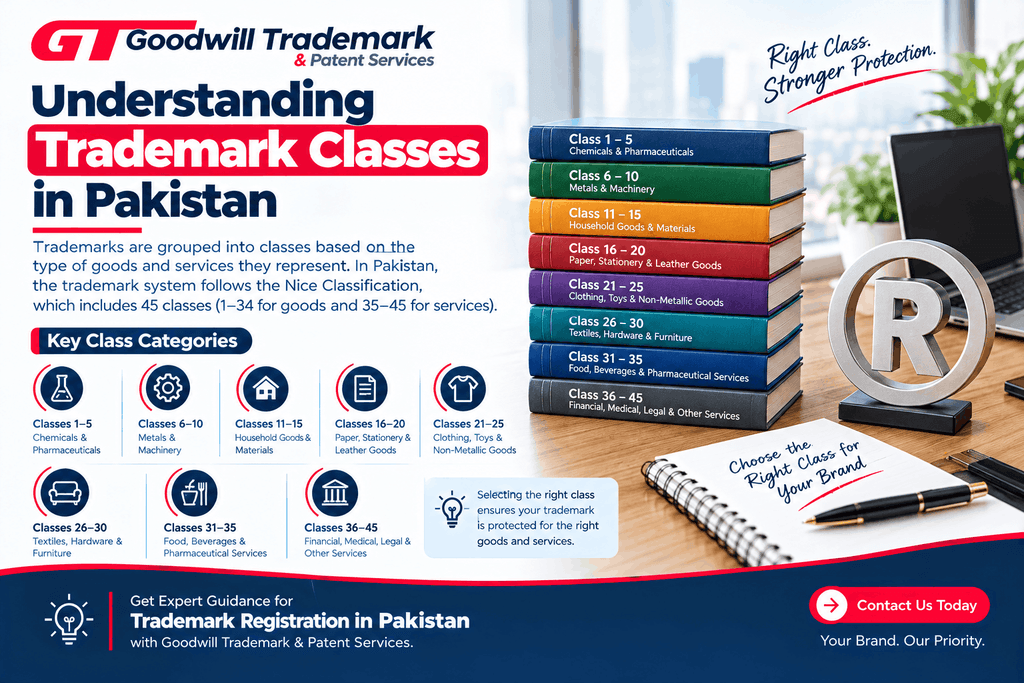
Trademark applications identify the goods or services for which protection is sought. These goods and services are organised under the international classification system.
Selecting the appropriate class is important because trademark protection is connected to the mark and the goods or services covered by the application.
Examples include:
- Class 25: Clothing, footwear and headwear
- Class 30: Many food products, including certain bakery goods, confectionery and spices
- Class 35: Advertising, business management and certain retail-related services
- Class 42: Scientific and technological services, software development and related services
- Class 43: Restaurant, café and catering services
These are illustrative examples, not a complete classification list. The exact class depends on the specific goods or services.
A business selling clothing under its own brand may need to consider a different class from a business providing advertising services. Businesses with several product lines or service activities may need protection in more than one class.
Under Pakistan’s trademark rules, an application is made for goods or services included in a particular class. Separate applications may therefore be necessary when protection is sought in multiple classes.
Documents Required for Trademark Registration in Pakistan
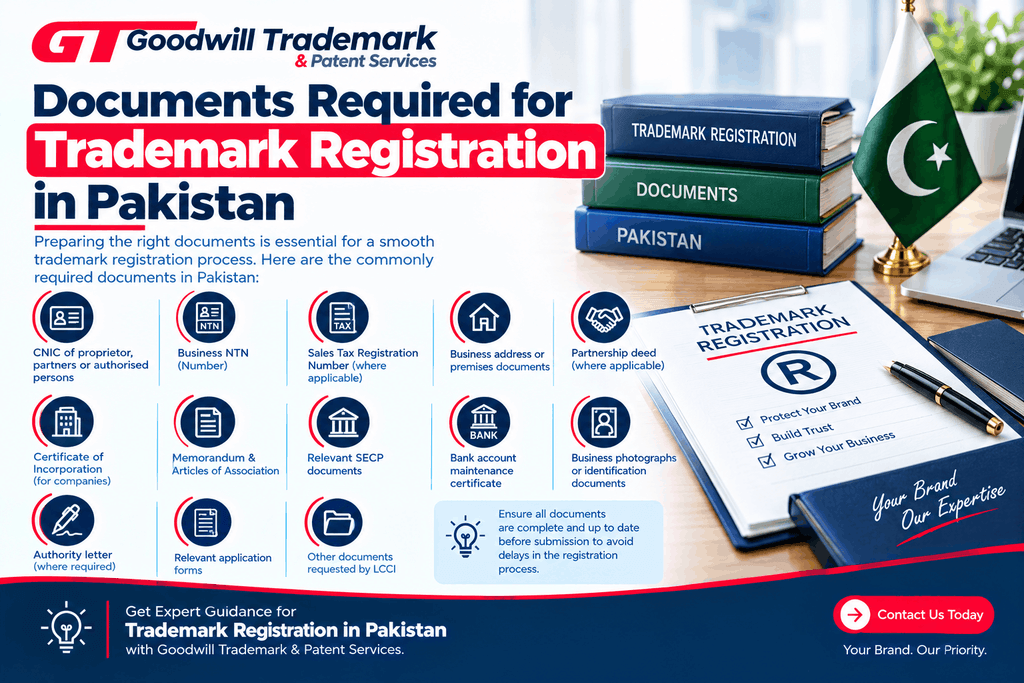
The documents and information required can vary depending on the applicant, the type of mark and the circumstances of the application.
Commonly required information may include:
- Applicant’s full legal name
- Applicant’s business or residential address
- CNIC details for an individual applicant, where applicable
- Company incorporation or registration details, where applicable
- Relevant business ownership information
- A clear representation of the trademark
- Details of the goods or services
- The appropriate trademark class
- Information about the mark’s use, where relevant
- Power of attorney or agent authorisation, where applicable
- Supporting evidence or declarations if required
A logo applicant should prepare a clear image of the mark. If a particular colour combination is an important part of the mark, the application should be prepared with the intended scope of protection in mind.
Applicants should confirm the current forms and requirements with IPO-Pakistan or their authorised representative before filing.
Step-by-Step Trademark Registration Process in Pakistan
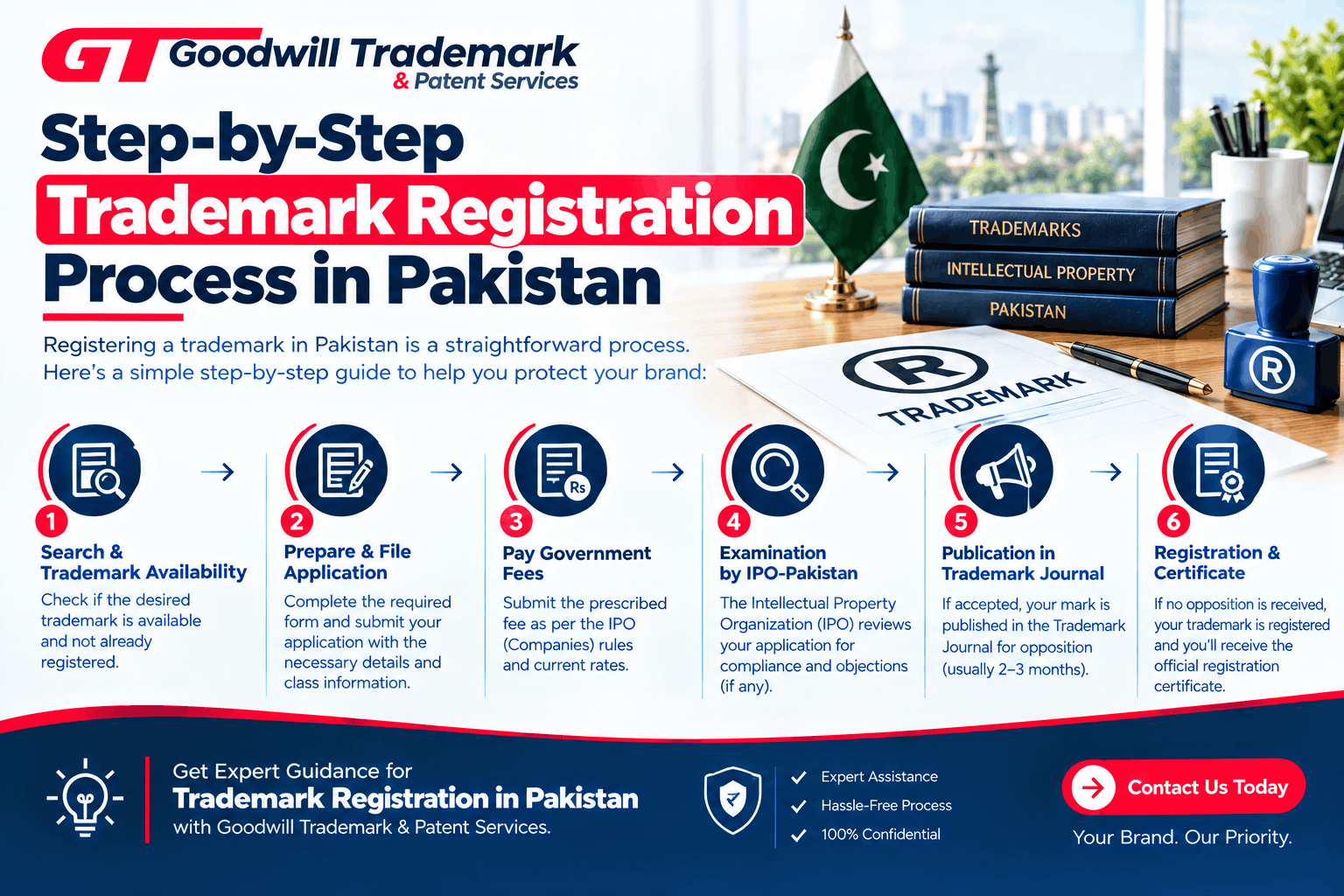
The following is a general overview of the trademark application process.
Step 1: Select Your Brand Name or Logo
Choose the mark you want to protect. A distinctive name is generally a stronger starting point than a term that simply describes the product or service.
Step 2: Conduct a Trademark Search
Check for identical or similar marks that may create a conflict. Consider spelling variations, pronunciation and the relevant goods or services.
Step 3: Identify the Correct Trademark Class
Determine the class that corresponds to your goods or services. If your business operates across several categories, assess whether additional applications may be necessary.
Step 4: Prepare the Application
Prepare the applicant’s details, representation of the mark, goods or services specification and other required information.
Step 5: File the Application
Submit the application through the applicable IPO-Pakistan procedure and pay the relevant official fee.
Step 6: Examination by the Trademark Registry
The Registry examines the application against the applicable legal requirements. If an objection or examination report is issued, the applicant may need to provide a response or make the required submissions within the prescribed period.
Step 7: Publication and Opposition
An application that proceeds to publication is advertised in the relevant trademark publication. This gives eligible third parties an opportunity to oppose registration in accordance with the applicable procedure.
Step 8: Address Any Opposition
If a third party opposes the application, the applicant may need to file a counter-statement and participate in the relevant proceedings. The outcome depends on the facts, evidence and applicable law.
Step 9: Complete Registration Formalities
If the application successfully completes the relevant stages, the applicant must fulfil the applicable registration requirements and fees before registration is completed.
Step 10: Maintain Your Trademark
After registration, keep your ownership records accurate, monitor potential conflicts and track renewal deadlines.
Important: Filing an application does not mean that the trademark has already been registered. Examination, publication, opposition and other formalities can affect the outcome and timing.
How Much Does Trademark Registration Cost in Pakistan?
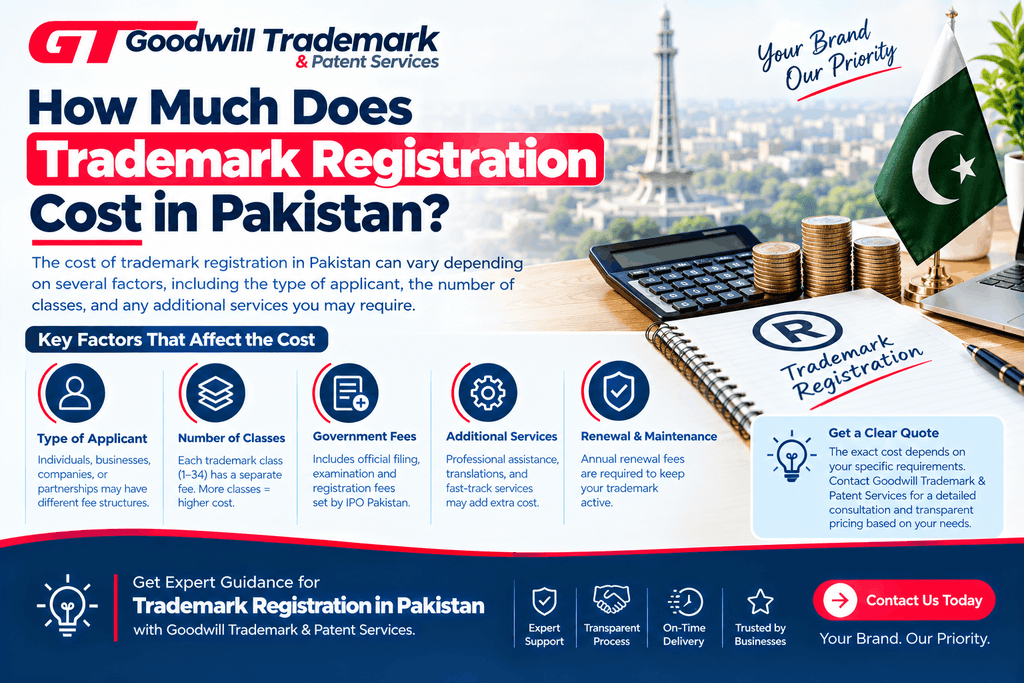
The total cost depends on the official fees applicable to the filing, the number of classes, the work required and whether professional assistance is used.
Potential cost components include:
- Preliminary trademark search
- Application filing fee
- Registration-stage fee
- Professional service charges, if applicable
- Additional fees for responses, opposition proceedings or other matters, if required
- Renewal fees when the registration reaches its renewal period
Pakistan’s trademark fee schedule is set out in the applicable Trade Marks Rules and may be amended. Applicants should verify the latest official fee schedule with IPO-Pakistan before filing rather than relying on an old online fee table.
Professional service charges are separate from official government fees unless a service provider clearly states that a quoted package includes both.
For an accurate quotation, confirm the mark, applicant details, intended goods or services and number of classes.
How Long Does Trademark Registration Take?
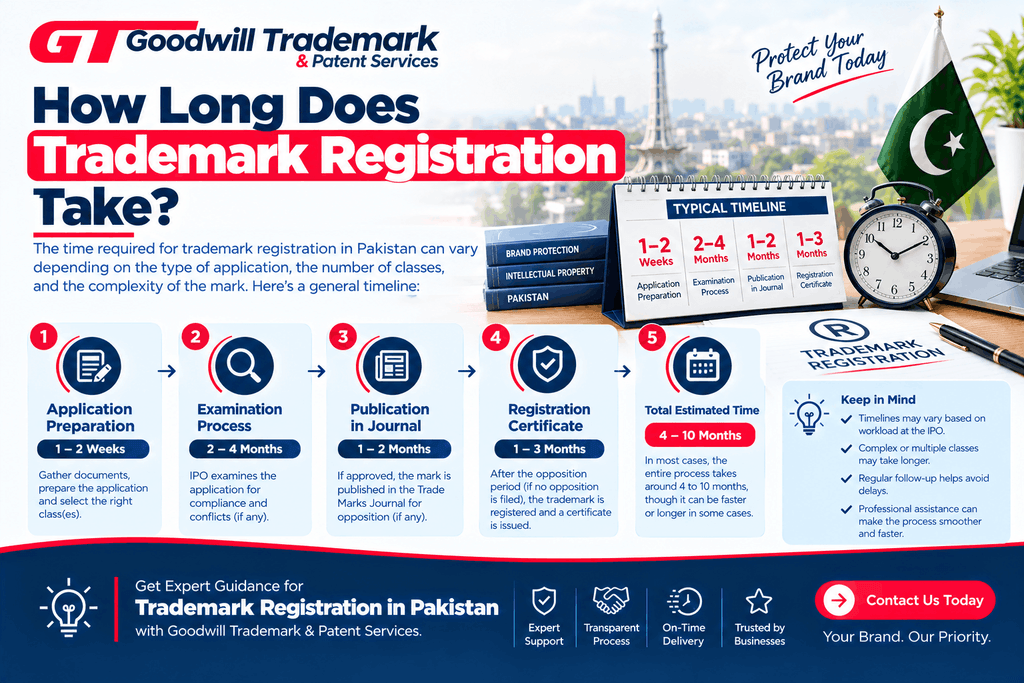
Trademark registration does not have one guaranteed completion time for every application.
The overall duration can depend on:
- The Registry’s examination process
- Whether an objection is raised
- How quickly the applicant responds
- Publication and opposition proceedings
- Whether additional documents or clarification are required
- The workload and procedures of the relevant authority
An application with no significant complications may progress differently from one involving an objection or opposition.
For this reason, businesses should avoid treating a particular number of weeks or months as a guaranteed registration timeline. A realistic estimate should account for the stages that apply to the individual application.
How Long Does a Trademark Registration Last?
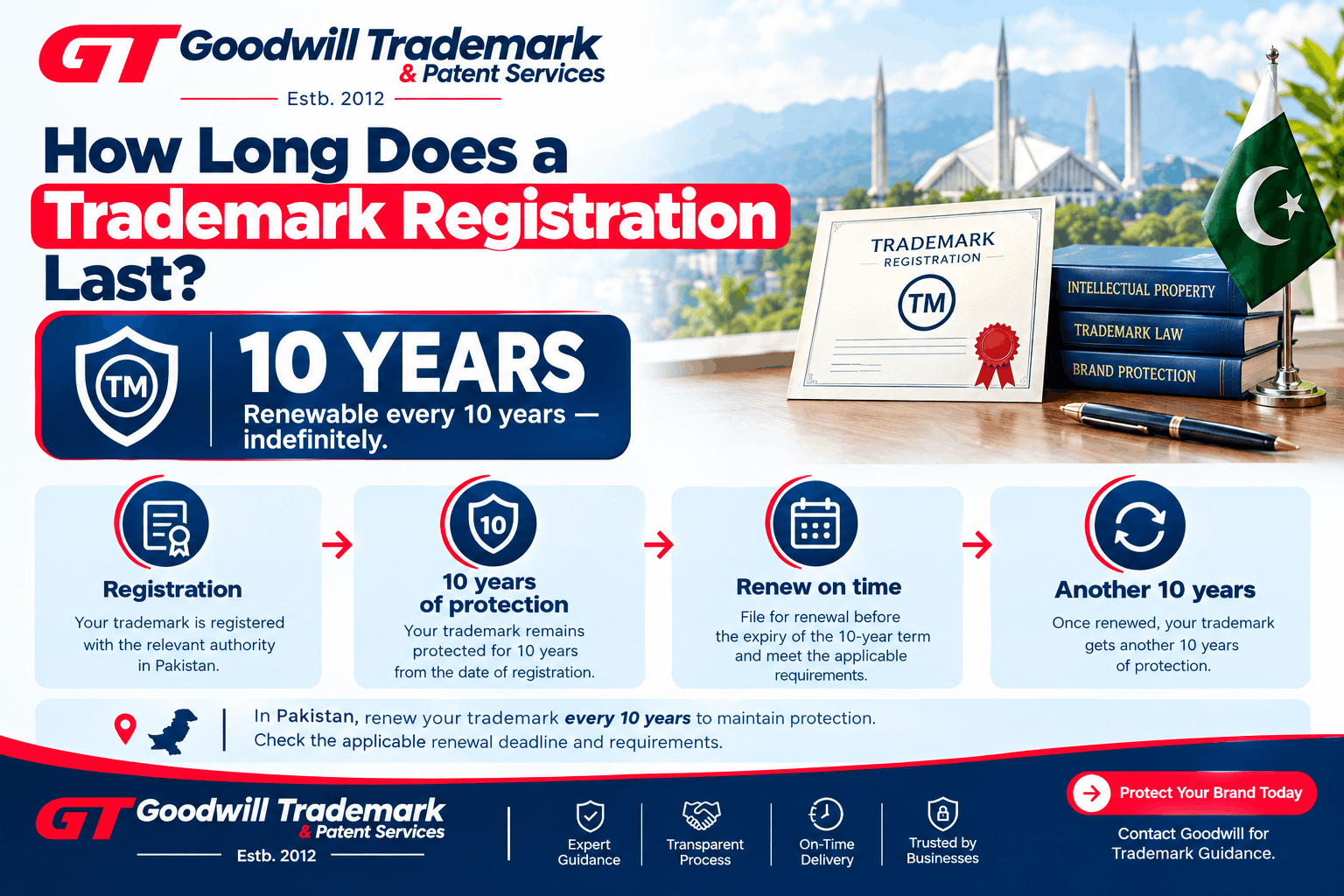
Under Pakistan’s Trade Marks Ordinance, a trademark registration generally lasts for 10 years, subject to the applicable provisions. It can be renewed for further periods of 10 years by completing the prescribed formalities and paying the relevant fee.
Trademark owners should maintain a record of the registration date and renewal deadline. If a business changes its name, address or ownership, it should also check whether the Registry’s records need to be updated.
Common Trademark Registration Mistakes to Avoid
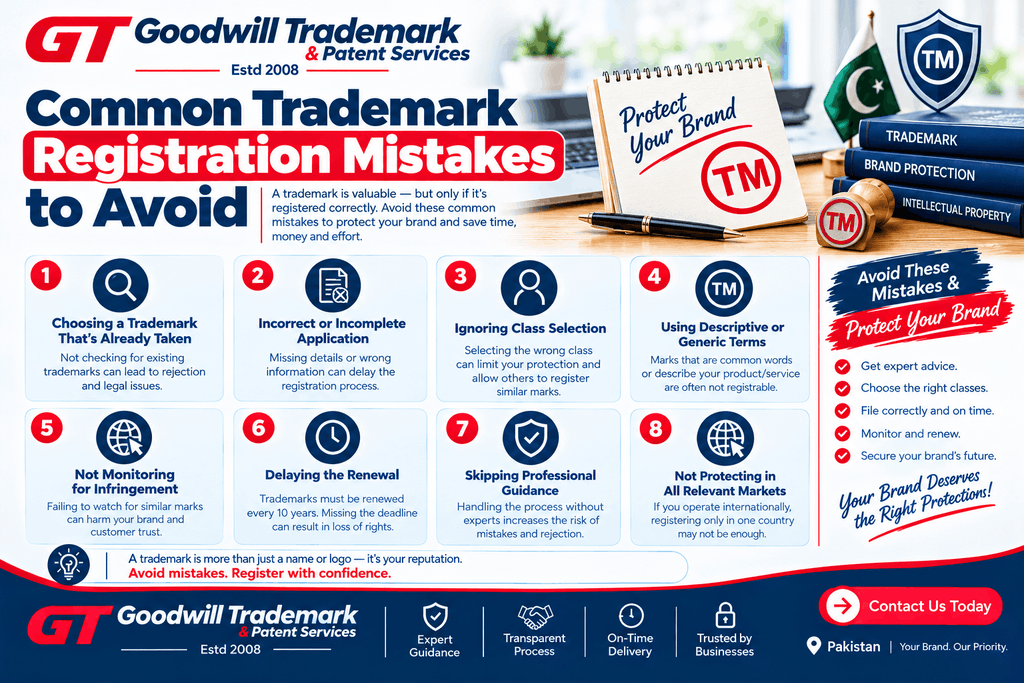
Choosing a Descriptive Brand Name
A name that merely describes the goods or services may face distinctiveness issues. Consider whether the proposed mark can distinguish your business from others.
Skipping the Trademark Search
Filing without checking for potentially conflicting marks can increase the risk of objections, opposition or disputes.
Selecting the Wrong Class
An incorrect or incomplete specification may leave important goods or services outside the intended scope of protection.
Filing Under the Wrong Owner
The applicant should reflect the intended legal owner. Mistakes can create complications when transferring or managing the rights later.
Assuming Application Means Registration
An application remains subject to the legal process. Do not advertise an application as a completed registration.
Ignoring Official Correspondence
Examination reports, objections and opposition notices may carry deadlines. Failing to respond appropriately can affect an application.
Forgetting Renewal
A registered trademark needs ongoing management. Missing renewal requirements may put the registration at risk.
Trademark Registration for Online Businesses in Pakistan
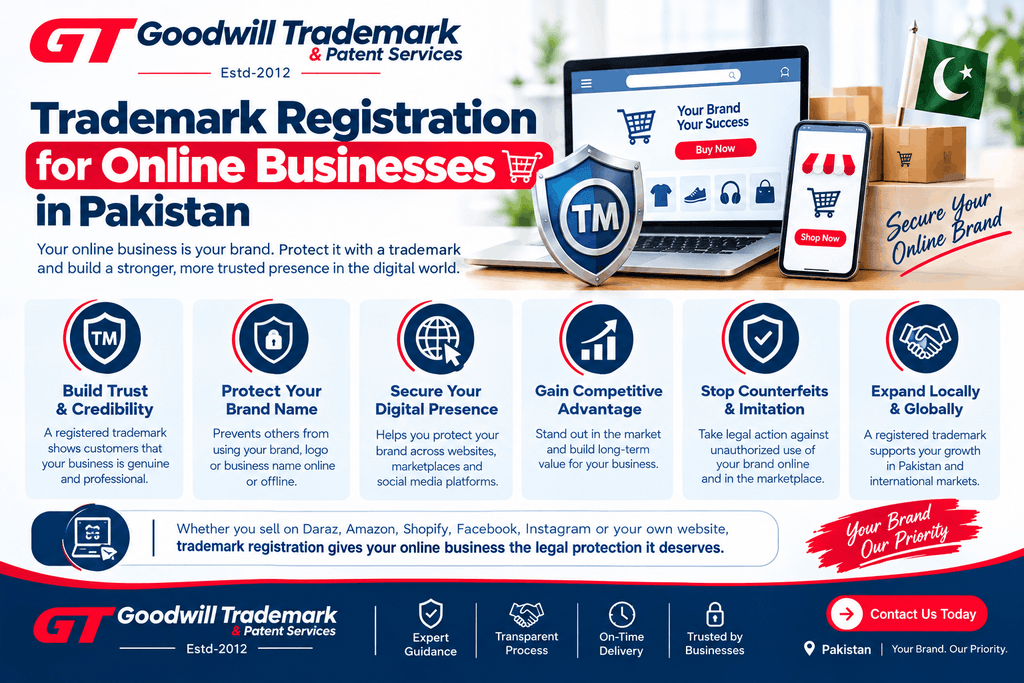
Online businesses also need to consider brand protection.
E-commerce sellers, online retailers, software companies and digital service providers may use their brand names on websites, social media, mobile applications, packaging and advertising.
Before launching a new online brand, businesses should consider:
- Checking whether the proposed name conflicts with existing marks
- Identifying the relevant goods or services
- Applying in the appropriate trademark class or classes
- Keeping evidence of the mark’s use
- Monitoring unauthorized use of the brand
- Considering protection in foreign markets if the business plans to expand internationally
Registering a domain name or creating a social media account does not, by itself, establish trademark registration.
Trademark Registration and International Protection
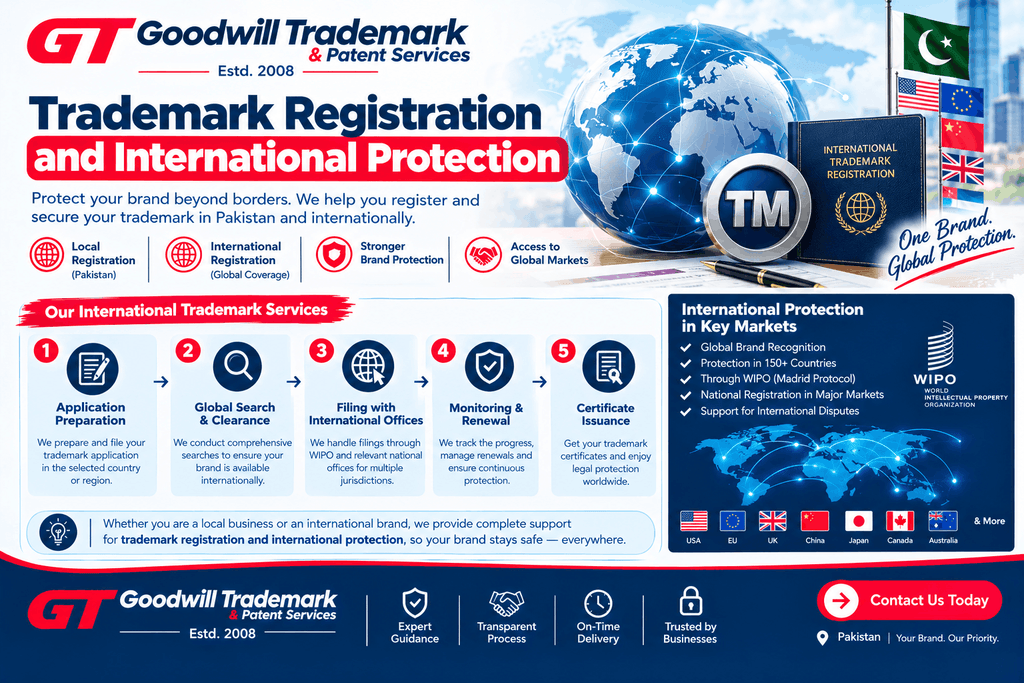
A Pakistani trademark registration does not automatically protect a brand in every country.
Businesses planning to export products, provide services internationally or sell through foreign marketplaces should assess trademark protection in each relevant market.
The available filing route, eligibility, fees and requirements depend on the target country and the applicant’s circumstances. International brand protection should therefore be planned according to the business’s expansion strategy.
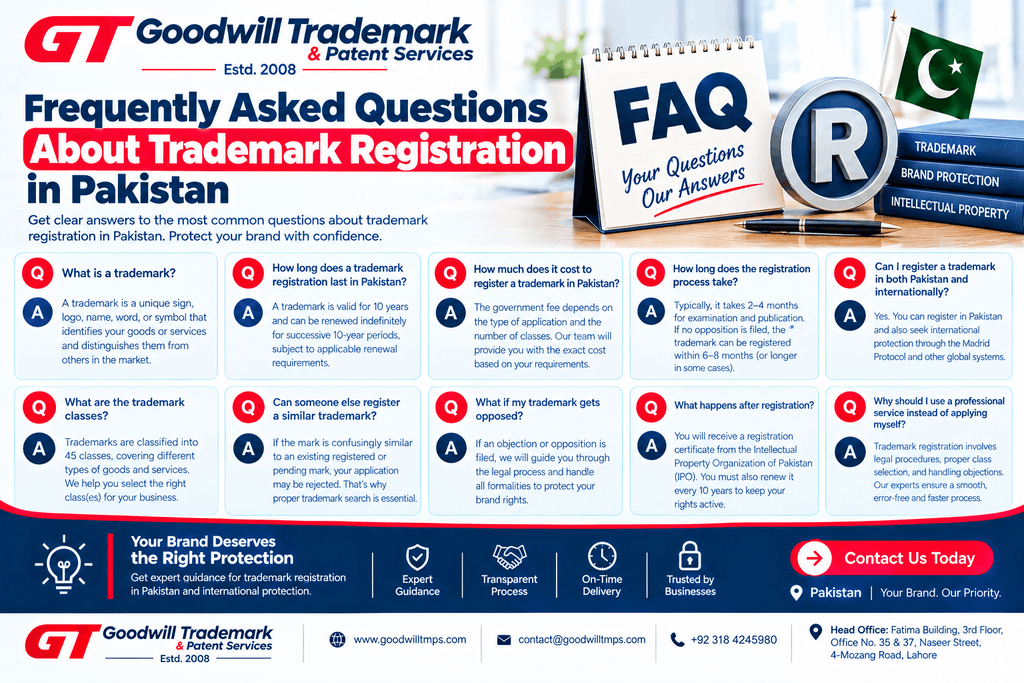
Frequently Asked Questions About Trademark Registration in Pakistan
1. How do I register a trademark in Pakistan?
Start by selecting a distinctive mark, conducting a search, identifying the correct goods or services and class, preparing the application and filing it through the applicable IPO-Pakistan procedure. The application must then complete the relevant examination and registration stages.
2. Can I register my business name as a trademark?
You may apply to register a business name as a trademark if it meets the applicable legal requirements. Business or company-name registration alone does not provide the same protection as trademark registration.
3. Can I register a logo separately from a brand name?
Yes, a business can consider separate applications for its word mark and logo. The appropriate filing strategy depends on the brand, the mark’s design and the protection the business seeks.
4. Do I need a separate application for each trademark class?
Separate applications are generally required for each class under Pakistan’s applicable trademark filing system. The correct approach should be confirmed against the current rules and filing requirements.
5. Does trademark registration protect my brand worldwide?
No. A Pakistani registration does not automatically provide worldwide protection. Businesses must assess protection in the countries where they intend to operate.
6. Can a trademark application be rejected?
Yes. An application may face objections or refusal for legal reasons, including issues relating to distinctiveness, prohibited marks or conflicts with earlier rights. The outcome depends on the particular application and applicable law.
7. Can another business oppose my trademark application?
An eligible third party may oppose a published application according to the applicable legal procedure. The applicant may need to respond and participate in opposition proceedings.
8. When should I renew my registered trademark?
Trademark registrations generally last 10 years and may be renewed for further 10-year periods, subject to the prescribed requirements. Owners should verify their exact renewal dates and current formalities.
Professional Trademark Registration Assistance in Pakistan
Protecting a brand starts with choosing a distinctive mark and following the correct registration procedure.
Goodwill Trademark & Patent Services assists Pakistani entrepreneurs, startups and established businesses with trademark-related services, including trademark searches, application preparation, class selection, filing support and guidance on examination objections and other registration matters.
Whether you are launching a new brand or protecting an established business name, our team can help you understand the process and prepare for the relevant requirements.
Contact Goodwill Trademark & Patent Services for professional trademark registration assistance in Pakistan.
Conclusion
Trademark registration is an important consideration for Pakistani businesses that want to protect the identity associated with their products and services.
A well-prepared application begins with a distinctive mark, a careful search, the correct classification and accurate applicant information. Businesses should also understand that filing is only the start of the process and that examination, publication, opposition and registration formalities may affect the outcome.
By planning trademark protection early and keeping registration records up to date, businesses can make more informed decisions about their brands.
For guidance on trademark registration in Pakistan, Goodwill Trademark & Patent Services can help you understand the process and prepare your application according to the applicable requirements.
goodwilltrademarkservices@gmail.com
Certified Intellectual Property counsel at Goodwill Trademark & Patent Services, helping clients clear, register, and litigate trademarks and patents in South Asian courts.