
A brand can take years to build, but another business can challenge its identity much sooner than you expect. A name that customers recognize, a distinctive logo, a product brand or a memorable slogan can become a valuable business asset. Protecting those elements should therefore form part of your business strategy from the beginning.
Trademark registration in Pakistan gives businesses a formal legal route to protect qualifying brand identifiers. It also plays an important role for foreign companies, international brands and overseas law firms dealing with trademark matters connected to the Pakistani market.
Whether you are launching a Pakistani startup, expanding an established company, exporting products or bringing an international brand into Pakistan, you should assess trademark protection before investing heavily in your brand.
What Is Trademark Registration in Pakistan?
Trademark registration is the process through which an eligible trademark is applied for and, if the application successfully completes the applicable procedure, registered with the relevant trademark authority in Pakistan.
Pakistan’s principal trademark legislation is the Trade Marks Ordinance, 2001, while the Trade Marks Rules, 2004 provide procedural rules and requirements.
A trademark can identify and distinguish the goods or services of one business from those of another. Depending on the circumstances and legal requirements, businesses may seek protection for brand names, words, logos, devices and other qualifying marks.
Registration should not be viewed simply as paperwork. It forms part of a wider strategy for building, protecting and managing a commercial brand.
Why Should Businesses Register a Trademark?
Businesses often spend substantial amounts on advertising, packaging, websites, social media and customer development. If another party adopts a confusingly similar brand, the business may face commercial and legal complications.
Trademark registration can help a business establish rights in its registered mark within the relevant scope of protection.
Build a recognizable brand
A distinctive trademark helps customers identify your goods or services and distinguish them from competitors.
Strengthen brand protection
Registration can provide a stronger legal position when dealing with conflicting marks or unauthorised use, subject to the applicable law and circumstances.
Protect business investment
Your brand may become increasingly valuable as your business grows. Protecting it early can form part of responsible intellectual property management.
Support expansion
A business that plans to enter new cities, industries or countries should consider trademark protection as part of its expansion strategy.
Create a commercial asset
Trademark rights can become relevant to licensing, franchising, assignments, acquisitions and other commercial transactions.
Trademark Registration for International Businesses

Foreign companies should not assume that registration in their home country automatically gives them the same trademark protection in Pakistan.
Trademark rights generally operate on a territorial basis. A business should therefore assess protection in every market that matters to its commercial plans.
For an international brand entering Pakistan, trademark planning should ideally begin before the commercial launch.
What Should You Protect?

Many businesses initially think only about their logo. That can be too narrow.
Depending on your circumstances and the applicable requirements, you may need to assess different brand elements separately.
Brand name
Your business may use a particular word or name to identify its products or services. If that name functions as a trademark and meets the relevant requirements, you may consider filing it for protection.
Logo
A distinctive visual design can form an important part of a brand’s identity.
Word and logo combination
Some businesses use their name together with a graphic design. You should consider carefully what elements your filing strategy should cover.
Slogan or tagline
A distinctive slogan may have trademark potential, but not every advertising phrase qualifies for registration.
Product or packaging elements
Certain non-traditional marks may receive protection in appropriate circumstances, subject to the legal requirements.
The correct filing strategy depends on the mark, the business, the goods or services and the protection you want to achieve.
How to Register a Trademark in Pakistan
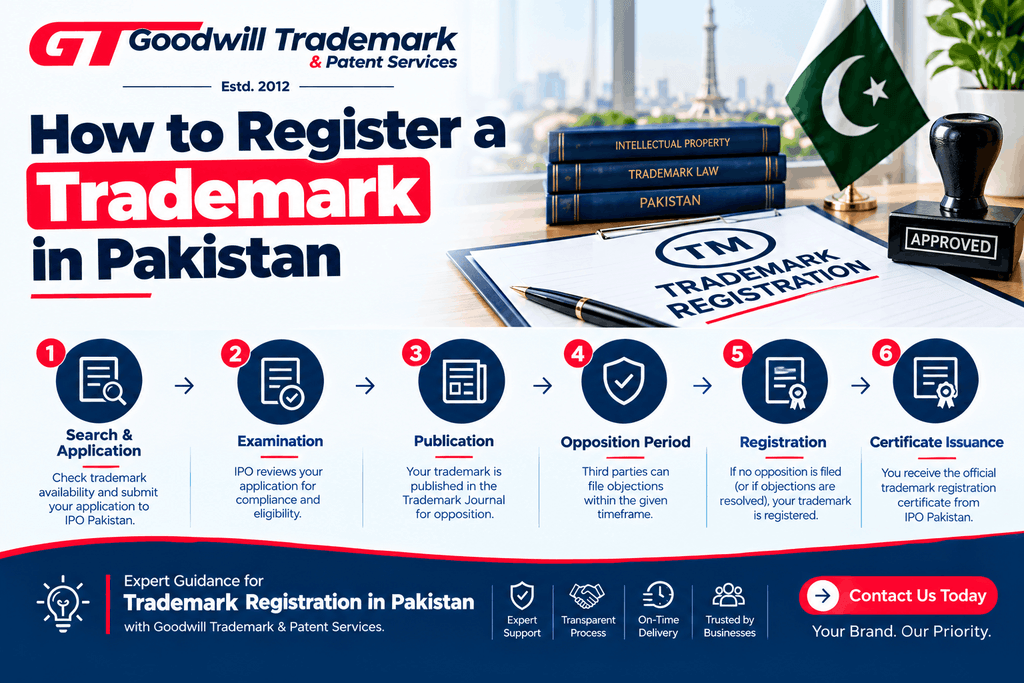
The exact procedure can vary according to the circumstances of the application, but businesses can generally approach the process as a series of stages.
1. Identify the trademark
Decide which brand name, logo or other qualifying mark you want to protect.
2. Assess distinctiveness
Review whether the proposed mark has the characteristics required for registration and whether it creates potential legal concerns.
3. Conduct a trademark search
Search for identical and potentially conflicting marks before investing heavily in the brand.
4. Determine the relevant goods and services
Identify the appropriate classification and specification for your business activities.
5. Prepare the application
Prepare the applicant information, representation of the mark, goods or services and other required information and documentation.
6. File the application
Submit the application through the applicable trademark filing procedure.
7. Respond to examination issues
The trademark authority may raise an objection or other issue during examination. If this happens, the applicant must assess the grounds and respond according to the applicable procedure.
8. Deal with publication and opposition
Where the application reaches the relevant publication stage, a third party may have an opportunity to oppose it under the applicable procedure.
9. Obtain registration
If the application successfully completes the required stages and no unresolved issue prevents registration, the mark can proceed to registration.
10. Manage the registration
Registration does not eliminate the need for ongoing brand management. Businesses should monitor their marks, maintain accurate ownership records and deal with renewal and other post-registration matters when required.
Trademark Objection in Pakistan
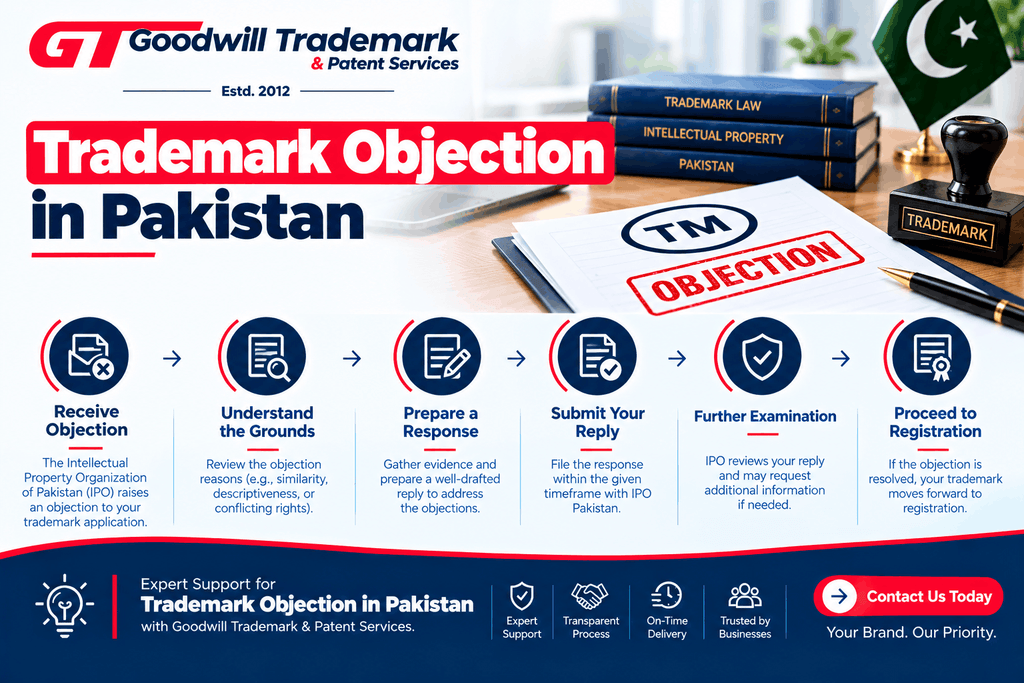
An examination objection means that the trademark application has encountered an issue that requires attention during the examination process.
The applicant should first understand why the authority raised the objection.
Depending on the issue, the response may involve:
- Legal arguments
- Clarification
- Amendments
- Evidence
- Supporting documents
- Other procedural steps
A generic response may not adequately address the specific grounds raised against the application.
Trademark Opposition in Pakistan
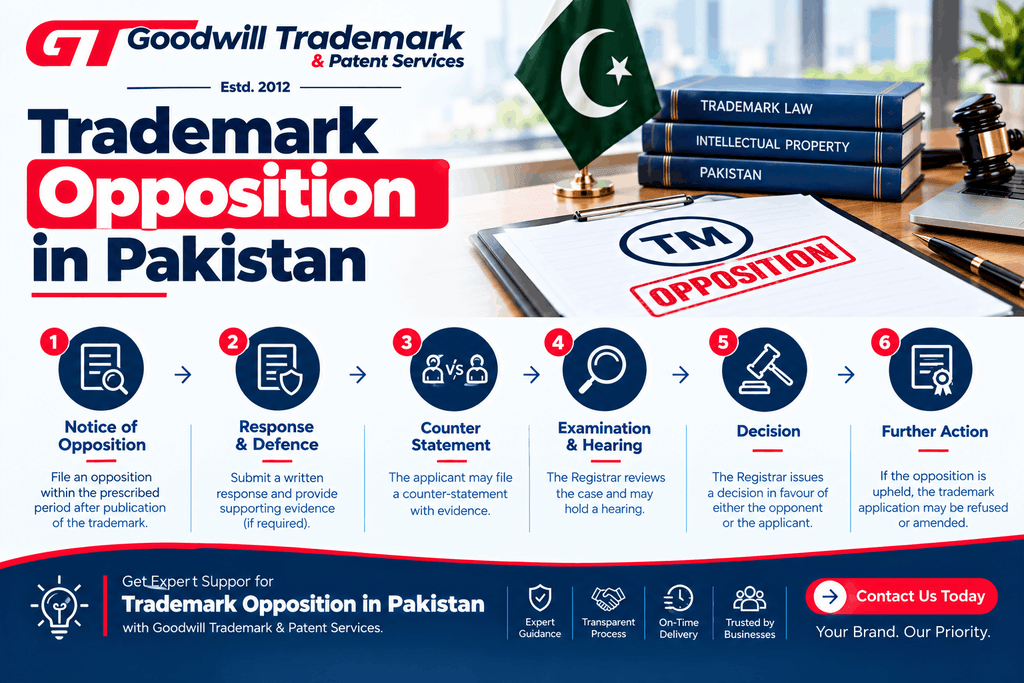
Trademark opposition is different from an examination objection.
An objection arises during examination of the application, while an opposition allows an eligible third party to challenge an application through the applicable opposition procedure.
A business may face opposition because another party believes that registration could affect its existing rights or interests.
If your application faces opposition, you should assess:
- Who filed the opposition
- Their claimed rights
- The similarity between the marks
- The relevant goods or services
- The evidence available
- The applicable legal grounds
- The procedural deadlines
Trademark disputes require careful handling because the outcome can affect the future use and value of a brand.
Trademark Registration for Foreign Companies Entering Pakistan

An international company should treat Pakistan as a separate trademark jurisdiction when planning market entry.
Before launching a brand, the company can assess:
Brand availability
Check whether the proposed trademark faces existing registrations or applications.
Local filing strategy
Determine what should be protected in Pakistan and under whose ownership.
Commercial partners
Review distributors, franchisees, licensees and other local partners who may interact with the brand.
Portfolio coordination
Ensure the Pakistani trademark strategy fits into the company’s international portfolio.
Enforcement planning
Consider how the business will monitor and respond to potentially conflicting use after entering the market.
This approach can reduce avoidable trademark risks during international expansion.
Support for Overseas Law Firms and International IP Professionals

International law firms often need reliable local assistance when their clients require trademark services in Pakistan.
A local trademark practice can support overseas counsel with matters such as:
- Pakistan trademark searches
- Local trademark filings
- Examination matters
- Objection responses
- Opposition proceedings
- Renewals
- Assignments
- Licensing matters
- Trademark portfolio management
- Local procedural coordination
For international counsel, the quality of local coordination matters because missed deadlines, incomplete information or misunderstandings about local procedure can affect the client’s position.
Trademark Protection Does Not End With Registration

A successful registration should become part of an ongoing intellectual property strategy.
Businesses should periodically review their trademark portfolio and consider:
- Renewal requirements
- Ownership changes
- New products
- New services
- New business names
- New logos
- New geographic markets
- Licensing arrangements
- Potential infringement
- Conflicting applications
- Portfolio consolidation
Companies with multiple brands can benefit from maintaining a structured trademark portfolio rather than treating every registration as an isolated matter.
Local and International Trademark Strategy: What Changes?

The fundamental objective remains the same: protect the brand in the markets where the business needs rights.
However, international businesses face additional considerations.
| Local Business | International Business |
|---|---|
| Protect Pakistani brands | Protect international brands in Pakistan |
| Assess local conflicts | Assess Pakistani conflicts before market entry |
| Plan Pakistani classes | Coordinate Pakistani classes with global portfolio |
| Monitor local competitors | Coordinate monitoring across jurisdictions |
| Manage local renewals | Manage cross-border deadlines |
| Expand from Pakistan | Enter Pakistan as a new market |
Neither approach should rely on a one-size-fits-all filing strategy.
goodwilltrademarkservices@gmail.com
Certified Intellectual Property counsel at Goodwill Trademark & Patent Services, helping clients clear, register, and litigate trademarks and patents in South Asian courts.