
Your brand name can become one of your most valuable business assets. Customers may recognise your company through its name, logo, product brand, slogan or other distinctive identity. As your business grows, protecting that identity becomes increasingly important.
If you are starting a business, launching a new product, expanding an established brand or entering Pakistan from another country, you should consider trademark protection as part of your business strategy.
This guide explains how to register a trademark in Pakistan, from choosing and searching your mark to filing an application, responding to objections, dealing with opposition and maintaining the registration.
It also explains the difference between official government fees and professional fees, an important distinction that businesses should understand before budgeting for trademark registration.
What Is a Trademark?
A trademark is a sign that identifies and distinguishes the goods or services of one business from those of another.
A trademark may, depending on the circumstances and applicable legal requirements, consist of a word, name, logo, device, combination of elements or another qualifying sign.
For example, a business may use a distinctive name and logo to identify its clothing, food, technology or professional services.
A trademark therefore does more than identify a business. It can become an important part of its reputation, goodwill and commercial identity.
Pakistan’s principal trademark legislation is the Trade Marks Ordinance, 2001, supported by the Trade Marks Rules, 2004.
Why Should You Register a Trademark in Pakistan?

Trademark registration can help a business establish legal rights in its registered mark within the applicable scope of protection.
Key benefits include:
Brand protection — Establish a stronger legal position for your registered mark.
Brand recognition — Protect the identity customers associate with your business.
Business growth — Build intellectual property assets alongside your commercial operations.
Commercial value — A trademark can become relevant to licensing, franchising, assignments and business transactions.
Market expansion — Include trademark protection in your strategy when entering new cities, industries or countries.
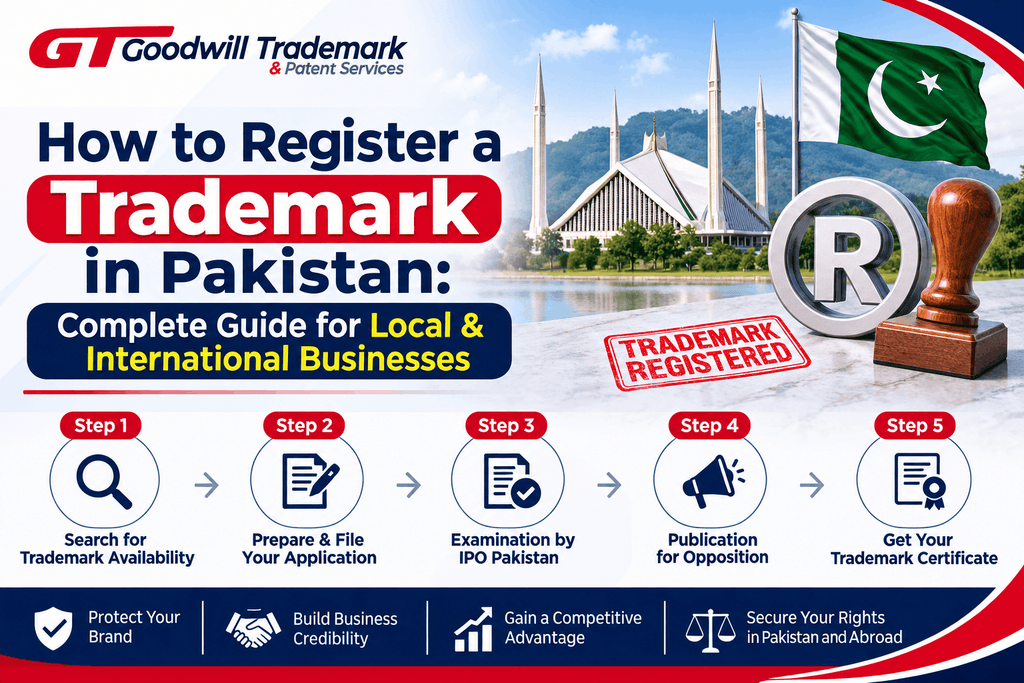
How to Register a Trademark in Pakistan

The registration process involves several stages. You should approach each stage carefully rather than treating trademark filing as a simple form-submission exercise.
Step 1: Choose Your Trademark
Start by identifying the brand element you want to protect.
This could include:
- Brand name
- Word mark
- Logo
- Device mark
- Combined name and logo
- Slogan or tagline
- Other qualifying brand identifiers
Choose a distinctive mark whenever possible.
A highly descriptive or commonly used expression may create greater registration difficulties than a distinctive brand.
Your trademark strategy should also consider whether you want to protect the name, logo, or both.
Step 2: Conduct a Trademark Search
Before filing, conduct a trademark search.
This is one of the most important stages of the process.
A search can help identify:
- Identical trademarks
- Similar trademarks
- Earlier applications
- Existing registrations
- Potentially conflicting marks
- Possible problems with your proposed brand
Do not limit your search to an exact spelling.
A potentially conflicting mark may look different but sound similar or create a similar commercial impression.
A proper clearance exercise should consider the relevant mark together with the goods or services for which you intend to use it.
A search cannot guarantee registration. The relevant authority will independently examine the application, and third parties may also have rights or grounds to challenge it.
Step 3: Determine Your Trademark Class
You must identify the goods or services for which you want protection.
The Trade Marks Rules provide a classification system for goods and services.
For example, a:
- Clothing business
- Restaurant
- Software company
- Pharmaceutical business
- Cosmetics brand
- Consulting firm
may have different classification requirements.
Do not select classes simply because another business uses them.
Instead, consider your actual commercial activities and realistic expansion plans.
Why does the class matter?
Trademark protection relates to the goods or services specified in the application.
Choosing the wrong class or an overly narrow specification can create problems later.
If your business operates across several areas, you may need to assess whether protection should cover more than one class.
Step 4: Identify the Applicant
The application should identify the appropriate proprietor or applicant.
This is particularly important for companies and international businesses.
Before filing, consider:
- Who owns the brand?
- Is the owner an individual or company?
- Is a parent company involved?
- Is a local subsidiary involved?
- Will a distributor use the brand?
- Will a franchisee or licensee use it?
International businesses should resolve ownership issues before filing rather than trying to correct ownership problems later.
Step 5: Prepare the Trademark Application
After completing the preliminary assessment, prepare the application using the applicable form and filing requirements.
The Trade Marks Rules prescribe forms for applications and other trademark proceedings. The Rules state that the forms in the relevant schedules are to be used for applicable matters.
For an ordinary application, the relevant filing information can include:
- Applicant details
- Address
- Trademark representation
- Goods or services
- Class
- Address for service in Pakistan
- Other information required by the applicable form
The Rules also contain specific requirements concerning applications and supporting material.
Step 6: Pay the Official Trademark Filing Fee
This is where businesses should understand an important distinction.
Official IPO-Pakistan Fees
The Intellectual Property Organization of Pakistan (IPO-Pakistan) publishes information concerning trademark fees and forms.
You can check the official IPO-Pakistan Trademark Fee & Forms page here:
IPO-Pakistan — Trademarks Fee & Forms
The official fee schedule should be checked at the time of filing because government fees and administrative requirements can change.
The Trade Marks Rules state that fees payable under the Ordinance and Rules are specified in the First Schedule.
Important: Official Fees Are Not Professional Fees
The IPO-Pakistan official fee is not the same as a trademark professional’s fee.
The official fee is the amount payable to the relevant government authority for the applicable filing, registration or other official proceeding.
A professional fee covers services provided by a trademark lawyer, attorney, agent or professional service provider.
Depending on the matter, professional services may include:
- Trademark search
- Legal assessment
- Class selection
- Application preparation
- Filing assistance
- Application monitoring
- Examination response
- Objection handling
- Opposition proceedings
- Documentation
- Renewal assistance
- Trademark portfolio management
Therefore, when comparing trademark registration costs, businesses should ask for a clear breakdown of:
1. Official government fees
and
2. Professional/service fees
These are separate cost components.
Do not rely on old fee figures
Online articles may contain historical fee amounts that no longer reflect the current official schedule.
For this reason, your article should direct readers to the official IPO-Pakistan fee and forms page for the current government charges rather than presenting an old fee table as permanently applicable.
Step 7: File the Trademark Application
Once the application, classification and required information are ready, submit the application through the applicable filing process.
The Trade Marks Rules provide that applications for registration are made to the Registrar and specify the applicable form and filing requirements.
At this stage, accuracy matters.
An incorrect:
- Applicant name
- Address
- Trademark representation
- Class
- Goods/services description
- Ownership detail
can create unnecessary complications.
Step 8: Trademark Examination
After filing, the application goes through examination.
The examiner may consider whether the application satisfies the relevant legal requirements and whether issues exist that affect registration.
If the authority raises an objection, you should first understand the exact reason.
Do not assume that every objection requires the same response.
Depending on the circumstances, the response may involve:
- Legal arguments
- Evidence
- Clarification
- Amendments
- Supporting documents
- Other procedural steps
A strong response should address the actual grounds raised against the application.
Step 9: Publication and Trademark Opposition
If the application progresses to the applicable publication stage, third parties may have an opportunity to oppose it under the relevant procedure.
This creates an important distinction:
Trademark Objection
An objection generally arises during examination of the application.
Trademark Opposition
An opposition is a challenge brought by another party through the applicable opposition procedure.
The two proceedings are not interchangeable.
If another party opposes your trademark, you should assess the opposition carefully and respond within the applicable procedural requirements.
Step 10: Trademark Registration
If the application successfully completes the relevant stages and no unresolved issue prevents registration, the trademark proceeds to registration.
The registration establishes rights according to the applicable law, registration details, goods/services and limitations.
Registration is not the end of trademark management.
You should continue to maintain and monitor your trademark rights.
Step 11: Maintain and Renew Your Trademark
Trademark owners should keep proper records of:
- Registration number
- Filing date
- Registration date
- Owner details
- Address
- Goods and services
- Renewal deadlines
- Assignments
- Licences
- Other relevant changes
The Trade Marks Ordinance provides for renewal of registrations, and the Rules include procedures and forms relating to renewal.
A business should therefore treat its trademark as an ongoing intellectual property asset rather than a one-time filing.
Documents Required For Trademark Filing in Pakistan

The exact requirements can vary according to the applicant and circumstances.
Depending on the application, you may need information or documents such as:
- Full name, business address and nationality of the applicant.
- 15 (fifteen) prints of labels or trademark / domain name or logo etc.
- Trading style, if any.
- Class
- Specification of goods or services.
- Colours claimed (if any).
- The first date of use of mark in Pakistan, if any, or statement that mark is proposed to be used. (If used in Pakistan, please provide proof there of by way of affidavit, publicity material, sale figures etc., which may be field later).
- If the application is for a series of marks, please indicate how many marks are in the series.
- Power of Attorney (Form TM-48) duly signed by the applicant and should be NOTARIZED.
- Language; English.
- If the word is in a language other than English, Urdu or regional Pakistani language, its translation and transliteration in the form of an affidavit (which may be filed later)
- To claim a convention priority, please forward the followings: –
- (a) Application number, filing date in the first convention country.
- (b) Certified copy of the priority documents.
- (c) Priority can be claimed within six months from the date of first convention application.
- (d) Priority documents can be filed within three months from the filing of convention priority application in Pakistan.
Trademark Registration for Foreign Companies in Pakistan

International businesses should approach Pakistan trademark protection as part of their global brand strategy.
A trademark registered in another country does not automatically mean that the business has equivalent trademark protection in Pakistan.
Before entering Pakistan, an international company should consider:
1. Search the Pakistani trademark landscape
Determine whether the proposed brand faces potentially conflicting marks.
2. Review ownership
Confirm which legal entity should own the Pakistani trademark.
3. Select appropriate classes
Match the Pakistani filing to the company’s actual commercial activities.
4. Coordinate with the international portfolio
Make the Pakistani filing consistent with the company’s global trademark strategy.
5. Review local commercial arrangements
Consider distributors, franchisees, licensees, manufacturers and other local partners.
6. Plan enforcement
Develop a strategy for dealing with potentially conflicting applications or unauthorised use.
This approach helps international businesses reduce avoidable problems when entering the Pakistani market.
Trademark Registration Support for International Law Firms

International law firms and IP professionals may need local assistance when their clients require trademark protection in Pakistan.
Goodwill Trademark & Patent Services can support Pakistan-related trademark matters such as:
- Local trademark searches
- Filing assistance
- Application monitoring
- Examination matters
- Objection responses
- Opposition matters
- Renewals
- Assignments
- Licensing support
- Trademark portfolio management
For international counsel, effective local coordination can make cross-border trademark management more efficient.
How Much Does Trademark Registration Cost in Pakistan?
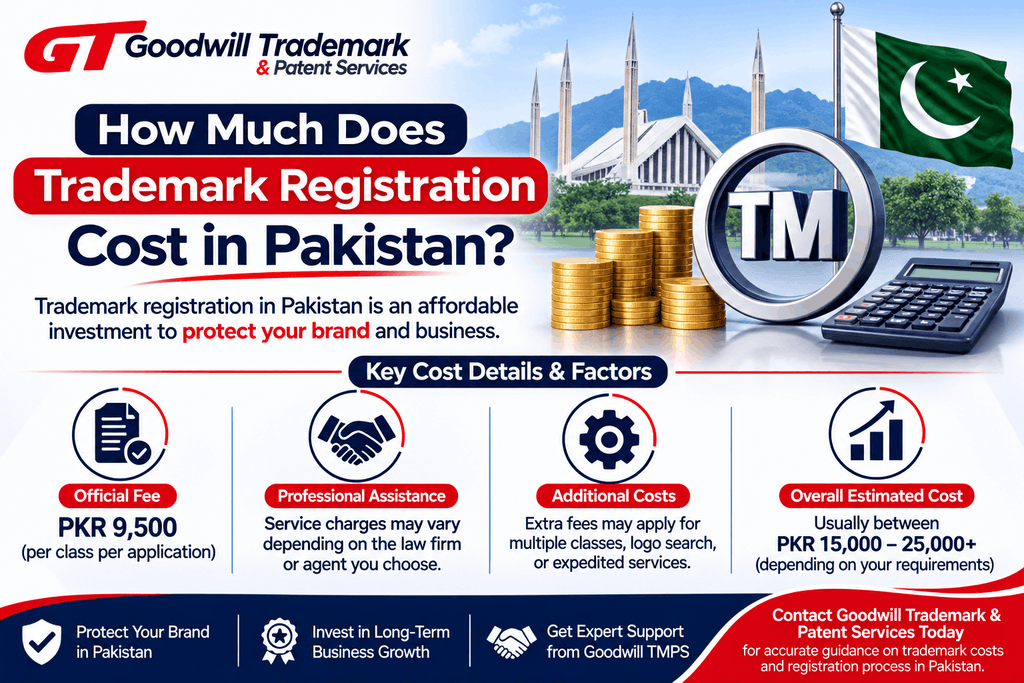
There is no single universal price for every trademark matter.
Your total cost can depend on:
- Number of trademark applications
- Number of classes
- Official government fees
- Professional fees
- Search requirements
- Objection proceedings
- Opposition proceedings
- Documentation
- Additional procedural requirements
Official fee vs professional fee
This distinction is particularly important:
Official fee: Paid to the relevant government authority according to the applicable official fee schedule.
Professional fee: Charged by a lawyer, trademark attorney, agent or professional service provider for the work they perform.
The IPO-Pakistan Trademark Fee & Forms page lists official fees and forms; it should not be treated as a schedule of professional fees charged by private practitioners. Check the official page for the current government charges.
For professional services, businesses should obtain a separate quotation that clearly explains what the service includes.
Why Choose Goodwill Trademark & Patent Services?

Goodwill Trademark & Patent Services (GT&PS) provides trademark and intellectual property services for local and international clients requiring trademark assistance in Pakistan.
Our trademark services include:
- Trademark Registration
- Trademark Search
- Trademark Objection Assistance
- Trademark Opposition
- Trademark Renewal
- Trademark Portfolio Management
- Trademark Assignment and Licensing Support
- Trademark Dispute and Litigation Support
- Brand Name Protection
- Logo Registration and Protection
- Support for International Clients
We have been providing our services since 2012 and work with clients in Pakistan as well as international clients who require support with Pakistan-related intellectual property matters.
Our approach focuses on understanding the client’s commercial objective, preparing matters carefully and providing professional support throughout the relevant process.
goodwilltrademarkservices@gmail.com
Certified Intellectual Property counsel at Goodwill Trademark & Patent Services, helping clients clear, register, and litigate trademarks and patents in South Asian courts.